
Ejemplos de ecuación cuadrática
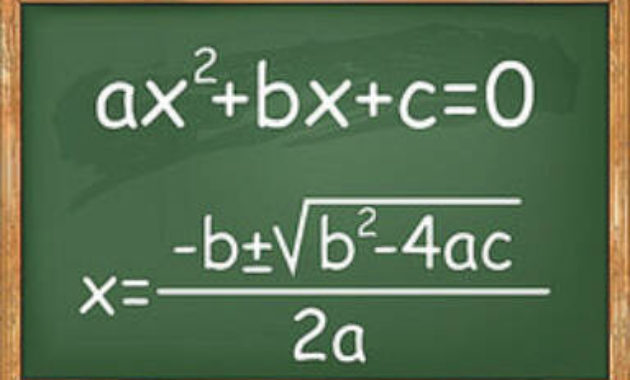
Una ecuación cuadrática es una ecuación de segundo grado, lo que significa que contiene al menos un término al cuadrado. La forma estándar es ax² + bx + c = 0, siendo a, byc constantes o coeficientes numéricos, y x es una variable desconocida. Una regla absoluta es que la primera constante "a" no puede ser cero.
Ecuaciones de forma estándar
A continuación, se muestran ejemplos de ecuaciones cuadráticas en la forma estándar (ax² + bx + c = 0):
- 6x² + 11x - 35 = 0
- 2x² - 4x - 2 = 0
- -4x² - 7x +12 = 0
- 20x² -15x - 10 = 0
- x² -x - 3 = 0
- 5x² - 2x - 9 = 0
- 3x² + 4x + 2 = 0
- -x² + 6x + 18 = 0
Estos son ejemplos de ecuaciones cuadráticas que carecen del coeficiente lineal o "bx":
- 2x² - 64 = 0
- x² - 16 = 0
- 9x² + 49 = 0
- -2x² - 4 = 0
- 4x² + 81 = 0
- -x² - 9 = 0
- 3x² - 36 = 0
- 6x² + 144 = 0
Estos son ejemplos de ecuaciones cuadráticas que carecen del término constante o "c":
- x² - 7x = 0
- 2x² + 8x = 0
- -x² - 9x = 0
- x² + 2x = 0
- -6x² - 3x = 0
- -5x² + x = 0
- -12x² + 13x = 0
- 11x² - 27x = 0
Aquí hay ejemplos de ecuaciones cuadráticas en forma factorizada:
- (x + 2) (x - 3) = 0 [upon computing becomes x² -1x - 6 = 0]
- (x + 1) (x + 6) = 0 [upon computing becomes x² + 7x + 6 = 0]
- (x - 6) (x + 1) = 0 [upon computing becomes x² - 5x - 6 = 0
- -3(x - 4)(2x + 3) = 0 [upon computing becomes -6x² + 15x + 36 = 0]
- (x - 5) (x + 3) = 0 [upon computing becomes x² − 2x − 15 = 0]
- (x - 5) (x + 2) = 0 [upon computing becomes x² - 3x - 10 = 0]
- (x - 4) (x + 2) = 0 [upon computing becomes x² - 2x - 8 = 0]
-
(2x + 3) (3x - 2) = 0 [upon computing becomes 6x² + 5x - 6]
Aquí hay ejemplos de otras formas de ecuaciones cuadráticas:
- x (x - 2) = 4 [upon multiplying and moving the 4 becomes x² - 2x - 4 = 0]
- x (2x + 3) = 12 [upon multiplying and moving the 12 becomes 2x² - 3x - 12 = 0]
- 3 veces (x + 8) = -2 [upon multiplying and moving the -2 becomes 3x² + 24x + 2 = 0]
- 5x² = 9 - x [moving the 9 and -x to the other side becomes 5x² + x - 9]
- -6x² = -2 + x [moving the -2 and x to the other side becomes -6x² - x + 2]
- x² = 27x -14 [moving the -14 and 27x to the other side becomes x² - 27x + 14]
- x² + 2x = 1 [moving "1" to the other side becomes x² + 2x - 1 = 0]
- 4x² - 7x = 15 [moving 15 to the other side becomes 4x² + 7x - 15 = 0]
- -8x² + 3x = -100 [moving -100 to the other side becomes -8x² + 3x + 100 = 0]
- 25x + 6 = 99 x² [moving 99 x2 to the other side becomes -99 x² + 25x + 6 = 0]
Hay muchos tipos diferentes de ecuaciones cuadráticas, como muestran estos ejemplos.



Deja una respuesta